

Design Patterns
Team design pattern I: Basic
Overview
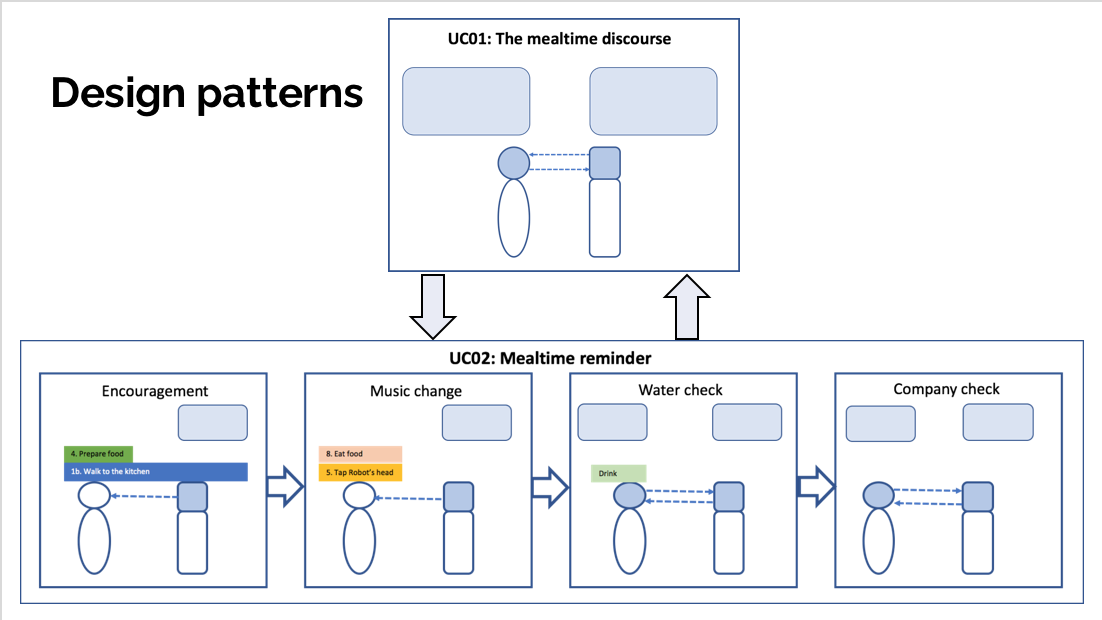
The design pattern above demonstrates the interactions between Nao and the PwD. The top pattern concerns UC01, the mealtime discourse. The bottom pattern concerns UC02, the mealtime reminder. In this section, the design pattern will be explained step by step.
First, it should be mentioned that UC01 and UC02 will follow after one another, meaning: if the conclusion from the mealtime discourse (UC01) is that the PwD has not yet had a certain meal, the mealtime reminder will start (UC02). At the next preprogrammed time, UC01 the mealtime discourse will start again, possibly once again causing the UC02 the mealtime reminder to start.
Purpose
The purpose of this design pattern is to show first how the mealtime discourse (UC01) works. Secondly, this design pattern aims to show how the meatime reminder (UC02) works step by step.
Steps Breakdown
UC01: The mealtime discourse
- Robot greets PwD by playing “start music”.
This way the robot gets the attention from the PwD, without startling the PwD too much. - Robot aks if PwD has eaten
- PwD answers question 2) from Robot
- Option a - PwD answers question 2) positively: Robot asks what PwD has eaten & plays “stop music” to finish the interaction
Option b - PwD answers question 2) negatively: UC02 starts
UC02: The mealtime reminder
- Robot encourages PwD to eat something and suggests the PwD to prepare the food. Consequently, the PwD will walk to the kitchen/food preparation area.
- Robot plays “Food preparation music”.
This way, after a couple interaction sessions, the PwD might link the food preparation music to the idea to go and eat something. - Robots asks PwD to tap the Robot’s head when the food is prepared.
This way, the robot hands over the lead to the PwD to continue the interaction. - PwD prepares the food.
- PwD taps the robot’s head to let the robot know the food is prepared.
This is a que for the robot to go to the next step of the interaction. - Robot now stops playing the “Food preparation music”.
- Robot compliments the food and wish the PwD a pleasant meal.
This is a way to reward the PwD’s job and to once again stress that eating is good for you. - PwD starts eating the food the PwD just prepared.
- Robot starts playing “Eating playlist”.
This change in music is meant to create the association between the music and the eating. After a given amount of time, the next step in the interaction commences: the water check. - Robot asks PwD if he/she is having a drink.
- PwD answers question 10) from robot.
- Option a - PwD answers question 10) positively: Robot compliments PwD for staying healthy and hydrated.
Option b - PwD answers question 10) negatively: Robot encourages PwD to have a drink. - PwD drinks his/her drink.
The completion of step 12) and the drinking of the PwD in step 13) are the ques for the robot to commence with the next step in the interaction: the company check. - Robot asks PwD asks whether he/she has company.
- Option a - PwD answers question 14) positively: Robot compliments PwD.
Option b - PwD answers question 14) negatively: comforts and supports PwD. - Robot salutes PwD and optionally plays “Stop music”.
This way, the PwD is made aware of the fact that the interaction has finished.
Team design pattern I addition: Caregiver as supervisor
Overview
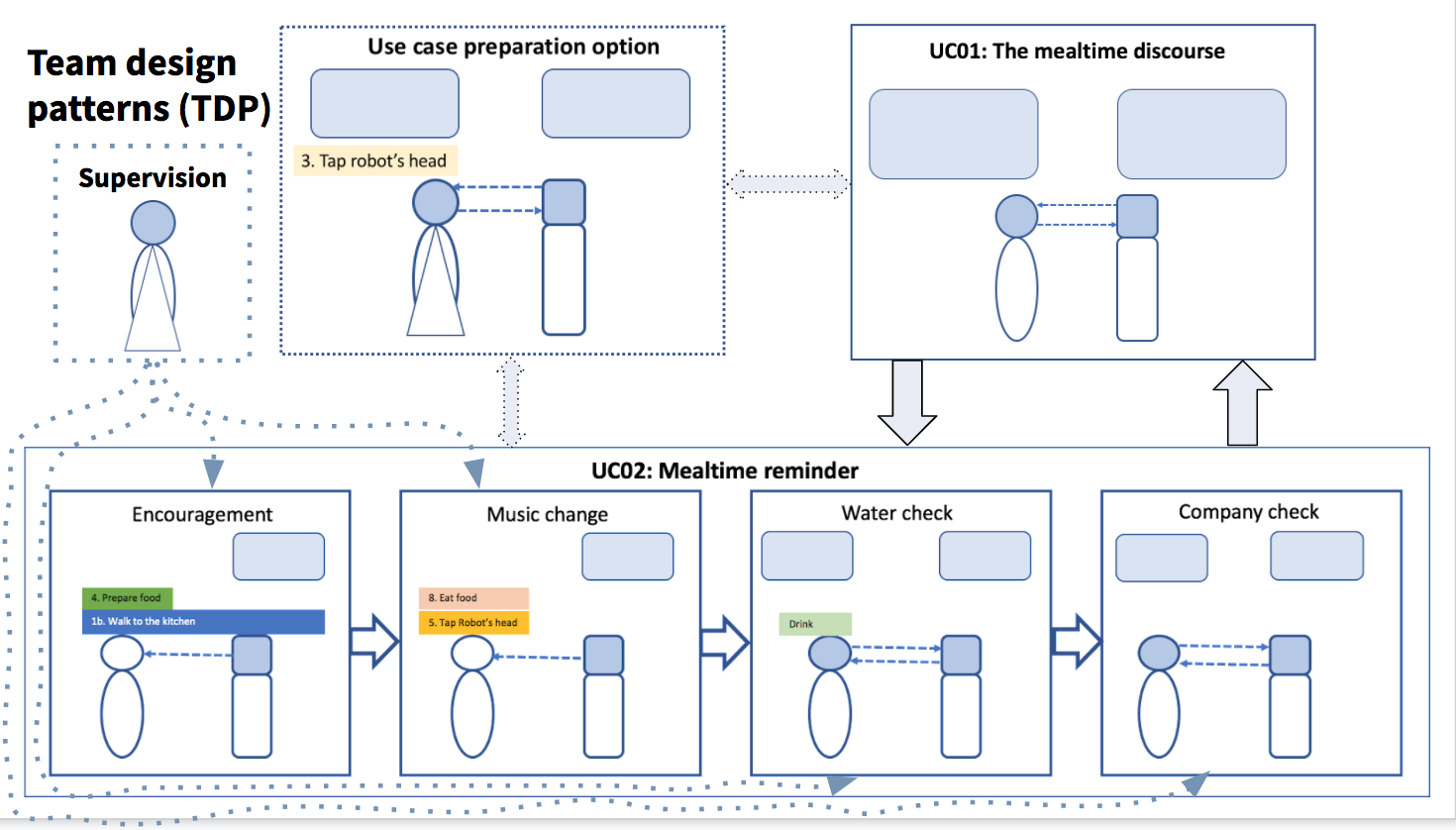
In the design pattern below, we have updated the previously explained design pattern demonstrates how the caregiver can interfere in the interaction between the robot and the PwD. As the updates are only suggestions, we marked those sections of the design patterns with a dotted line.
Purpose
The purpose of this design pattern is to first show how the caregiver of the PwD could possibly confirm or reject the start of both the UC01 and the UC02. This opportunity could be of use if the caregiver is at home with the PwD and would like to have the mealtime discourse with the PwD his/herself and does not want the robot to have that conversation at that moment.
Secnodly, if UC02 has commenced, another purpose of this updated overview is to show that the caregiver can impact each phase of the UC02 in any step of the interaction of the Robot with the PwD.
One of the advantages of this updated overview, which sees the caregiver as a supervisor of the PwD-Robot interaction, is that the supervisor could also alarm the robot if the PwD is not answering the robot’s questions correctly/truthfully. Also, if the PwD does not know what to answer to the robot’s questions, the supervisor can help the PwD.
Steps Breakdown
UC Preparation
- Robot asks the supervisor if she wants UC01/UC02/neither of the use cases to commence.
- Supervisor answers the robot’s question.
- Supervisor could alternatively answer the robot’s question by tapping the robot’s had.
For instance: tapping the robot’s had could represent the stimulation of the start sign for UC01 or UC02. Not tapping the robot’s had within a couple seconds might be the sign for the robot that the robot can commence UC01 or UC02.
The supervisor
This design addition suggestion does not consist of clearly defined steps, but is just intended to demonstrate that the caregiver, as supervisor, could have the opportunity to impact the mealtime reminder interaction between the robot and the PwD. However, in the interaction design patterns, the interaction between the supervisor, the PwD and the robot will be further explained.